What Changed for Computing Pipelines After June 29, 2023
On June 29, 2023, the day the 2023 Supreme Court opinion in Students for Fair Admissions v. Harvard and SFFA v. UNC came down, university computing departments and STEM foundations entered an immediate compliance scramble. Chief Justice Roberts's majority opinion strictly governed Title VI and Fourteenth Amendment admissions criteria. University legal teams immediately widened that net.
Between July and October 2023, legal compliance committees across public land-grant and private research institutions froze or revised application portals for the 2024–2025 academic cycle. General counsels audited scholarship criteria, summer bridge applications, and undergraduate fellowship funding records for any race-exclusive language. In many departments, portals simply went dark while committees debated what the ruling actually forbade.
Federal guidance soon established the actual boundaries. On August 14, 2023, the U.S. Department of Education and the Department of Justice issued a joint Dear Colleague Letter and a 12-page Q&A document clarifying that while race-exclusive admissions were barred, targeted outreach, recruitment, and pathway programs remained permissible. That clarification defined the central problem for advocates: distinguishing between reactive compliance that abandons underserved students and strategic restructuring that preserves intersectional support. When we examine the first principles of access in our research, we see that dismantling exclusionary structures requires separating legal boundaries from administrative panic.
Rewriting Eligibility Criteria Without Losing Black, Latinx, and Indigenous Students
During the autumn 2023 restructuring window, computing department chairs and Broadening Participation in Computing (BPC) committees evaluated two distinct adaptations in public program announcements: broad socioeconomic substitutions versus mission-aligned experiential criteria. Comparing their outcomes makes the stronger choice clear.
Many committees rejected pure Pell-eligibility or flat household income cutoffs because those metrics could miss Black, Latinx, and Indigenous students living in high-cost-of-living urban districts or underserved rural regions. High-cost-of-living urban income distortions meant that a family in a major metropolitan area could earn just above a flat national threshold while remaining locked out of well-funded public schools. Relying solely on generic first-generation flags or broad income brackets diluted reach to the exact students these initiatives were built to support.
What preserved reach was tying eligibility to structural educational barriers and documented mission alignment. Program directors replaced demographic checkboxes with rubric-scored prompts of about 250 to 500 words assessing an applicant's demonstrated commitment to broadening participation in computing or lived experience overcoming limited access to Advanced Placement Computer Science A courses. Revised rubrics implemented between September 2023 and January 2024 weighted institutional context—specifically whether an applicant's secondary school offered fewer than two foundational computer science courses or belonged to a Title I district.
Aligning Rubrics With Educational Context
Weighting Title I secondary school course availability alongside a candidate's track record of broadening participation in computing anchors selection in structural context rather than flat income cutoffs.
Other programs preserved their cohorts by tying fellowship eligibility directly to enrollment at specific under-resourced high schools and Minority-Serving Institutions (MSIs). When we center the structural realities of where students learn, we maintain proven pathways for underrepresented technologists without relying on demographic checkboxes.
How Institutional Funding Records Reflect the New Compliance Landscape
Grant re-solicitations executed over the months following June 2023 converted individual demographic-restricted student stipends of roughly $5,000 to $10,000 into multi-year departmental capacity grants open to all enrolled students at partner institutions. To protect computing pipeline funding from legal challenges under Title VI and 42 U.S.C. § 1981 (Section 1981 of the Civil Rights Act of 1866), private STEM foundations and university sponsors restructured their disbursement mechanisms. Rather than awarding demographic-bound fellowships directly to individual undergraduates, grantmakers shifted capital into institutional capacity sub-awards directed at Minority-Serving Institutions.
This shift exposed deep operational friction inside universities. Risk-averse university general counsels often over-corrected by shuttering targeted fellowships entirely, while program directors worked to keep computing labs accessible. Navigating that friction requires a clear understanding of how legal exposure actually operates across different grant architectures. Shifting individual stipends into institutional capacity grants at Minority-Serving Institutions shields programs from individual-level Title VI challenges, though public universities located in states with sweeping state-level bans on diversity, equity, and inclusion expenditures face separate statutory restrictions on how internal state appropriations can be sub-awarded.
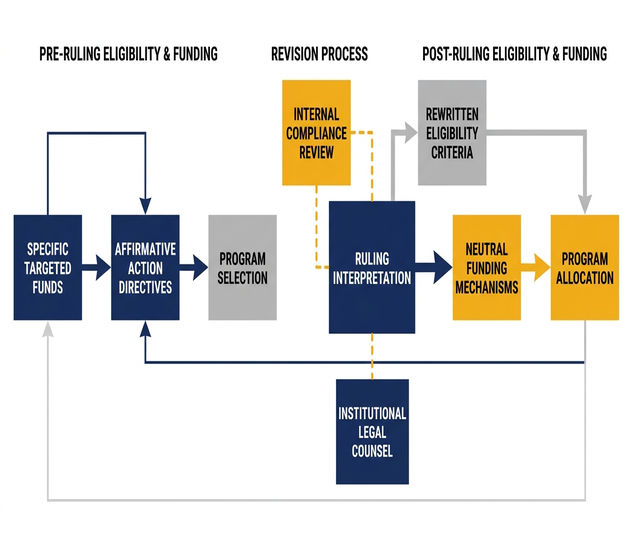
Auditing your own fellowship and grant language requires looking closely at where legal risk sits. High-risk structures included fellowships restricting applicant pools by demographic self-identification on university web portals; legally durable structures paired open-eligibility research cohorts with mission-driven selection criteria requiring experience in community-engaged computing.
- High-Risk Individual Stipends: Direct awards in that $5,000-to-$10,000 range restricted by demographic checkboxes on university web portals, carrying immediate Section 1981 and Title VI exposure.
- Legally Durable Cohort Grants: Multi-year departmental capacity sub-awards directed to HBCU, HSI, and TCU computing departments, open to all enrolled students at those partner institutions.
- Legally Durable Selection Rubrics: Open-eligibility research cohorts evaluated through rubric-scored essays on community-engaged computing and prior barriers to foundational coursework.
Outreach and Program Design Priorities for STEM Advocates Now
During a recent autumn curriculum review, I watched a faculty committee realize their passive national web portal would no longer bring in a diverse summer research cohort if they simply deleted a demographic field and waited for applications. When application forms cannot screen by race, where and how programs recruit determines who enters the computing pipeline.
Principal investigators and computing diversity directors have reallocated budgets from passive national portals to direct, high-touch recruitment at community colleges, Tribal Colleges and Universities (TCUs), Historically Black Colleges and Universities (HBCUs), and Hispanic-Serving Institutions (HSIs). Recruitment cycles for summer research experiences shifted timelines backward to run from September through November, allowing principal investigators 8 to 12 weeks to conduct in-person informational sessions at partner HBCUs, HSIs, and TCUs before January application deadlines. Centering recruitment talks at culturally grounded computing student organizations ensures that recruitment reaches students before the application window even opens.
- Move recruitment timelines to autumn: Dedicate the September-to-November window to 8 to 12 weeks of on-campus informational sessions at partner MSIs and community colleges.
- Partner with student chapters: Direct outreach funds to culturally grounded student chapters where underserved computing majors already build community and technical skills.
- Deploy three-part evaluation matrices: Replace legacy demographic screening fields with structured evaluation matrices scoring three concrete areas: prior engagement with culturally grounded student chapters, history of peer mentoring in computing, and specific proposals for applying computing research to community disparities.
You sit down at your desk with your department's upcoming summer research application and funding rubric spread across the screen. You highlight the legacy compliance-flagged demographic checkbox, delete it from the portal template, and type in a 500-word rubric-scored prompt asking how the applicant has navigated limited access to foundational computing courses, mentored peers through student chapters, and partnered with underserved communities.