
HBCU Applicants Can Disappear Before Human Review
A qualified applicant can lose access to a computing job before anyone reads their credentials. When an automated resume screener evaluates an HBCU degree, campus leadership, and work history without an intersectional audit, it can turn those experiences into grounds for exclusion. The research problem begins at that decision point: which combinations of resume features change how the system ranks a candidate?
Testing race and gender separately provides a different view from testing how institutional affiliation, culturally specific leadership, and employment pathways interact. A name-swapping correspondence audit holds a resume constant while changing a candidate name. That approach can isolate a particular signal. It leaves other questions for the audit team to investigate, including whether an education header changes how the parser interprets leadership elsewhere on the page.
In the semester-long collaboration examined here, researchers and HBCU computing students built the inquiry around those interactions. Before the academic term, the research team explored baseline screening behavior and considered conventional correspondence-audit designs. The partnership then moved toward multi-attribute resume variants, bringing students into decisions about what the audit should measure.
That shift matters because a resume parser breaks a document into components such as education blocks, organization headers, and skill categories before producing a relevance ranking. A leadership entry can therefore travel through a different processing pathway from a programming-language entry, even when both describe relevant preparation.
The central question became more precise: does the screener preserve evidence of technical readiness when that evidence arrives through HBCU institutions and culturally specific experiences? Answering it required students to help define the evidence, select the contrasts, and interpret the resulting scores.
Students Rewrote the Audit Before They Ran It
Early in the semester, undergraduate computing students brought their technical rejection logs into a review of the initial protocol. Faculty investigators arrived with a baseline rubric. Students arrived with concrete recruiting experiences that challenged its priorities.
The encounter changed the research workflow. Instead of simply labeling examples selected by faculty, students helped decide which resume features deserved controlled testing. The team replaced preselected fairness benchmarks with an iterative rubric grounded in Dr. Jakita O. Thomas’s intersectional computing framework. Within this semester-length project, that framework guided the choice to examine interacting experiences rather than treating demographic categories as independent explanations.
The practical task was translation. “My campus leadership gets overlooked” expresses an important concern; an audit needs a testable version. A student team could translate that concern into a comparison between a service-focused leadership description and a description that explicitly names the coordination, budgeting, or technical work involved. The responsibilities must remain equivalent for the comparison to answer a useful question.
Turn Recruiting Friction Into Testable Features
Small analytical pods worked through that translation in recurring studio sessions. Their work connected lived recruiting friction to parser inputs: an institutional name, an organization title, a work-history structure, or a phrase describing responsibility. Each proposed feature needed an explanation of why it might matter and how the team would vary it without changing the applicant’s underlying qualifications.
The semester moved through onboarding and literature review, rubric redesign and corpus construction, then parser testing and synthesis. These phases gave the inquiry a rhythm while preserving room to change direction. The calendar made prioritization unavoidable: students and faculty had to choose which suspected screening behaviors warranted sustained attention.
For research & publications, the important methodological record is the chain connecting a recruiting concern to a variable, a controlled comparison, and an interpretation. Preserve that chain. It makes the students’ contribution visible in the research itself.
Resume Triads Made Campus Experience Auditable
A name swap asks what happens when a name changes. A controlled resume triad can ask how a screener responds when institutional affiliation, leadership language, or a regional work pathway changes while technical preparation stays fixed.

Student teams held grade point averages, programming languages, and core coursework constant as they examined campus involvement and nontraditional work experience. This gave their comparisons a stable center. A score change could then be examined against the deliberately altered feature, rather than a moving collection of qualifications.
Give Each Triad a Specific Question
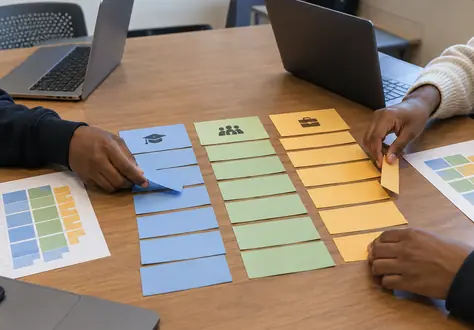
The triad structure becomes useful when each set has a clear purpose. Teams can organize the corpus around these comparisons:
- Institutional headers: Vary the education affiliation across a controlled set while preserving degree field, coursework, and demonstrated skills. Record whether the parser extracts the education entry consistently and whether the relevance score changes.
- Culturally specific leadership: Compare ways of naming and describing a Divine Nine chapter role or another culturally specific organization role. Keep the underlying responsibilities equivalent, including service coordination and leadership work.
- Regional co-op histories: Vary how a nontraditional internship or co-op pathway is organized and described while holding its substantive technical work constant. Examine whether the screener recognizes the experience as relevant.
Separate triads establish interpretable contrasts. Combining selected features afterward lets teams investigate whether institutional affiliation, leadership wording, and work-history structure change the scoring pattern together. Career-break framing belongs in an explicitly defined comparison too, rather than being changed incidentally alongside other attributes.
Students found a particularly consequential distinction: service-focused leadership phrasing drew a stronger scoring penalty than nonstandard section headers. That result redirected attention from document tidiness toward the language through which students represented their responsibilities.
Because this semester-length audit examines black-box outputs without access to proprietary training weights, teams must pair input-output perturbation with qualitative rubric reconstruction rather than wait for source-code disclosure.
Rubric reconstruction means writing down the apparent preference suggested by a controlled comparison, then testing that interpretation against another variant. For example, a team might ask whether explicit technical verbs affect recognition of work that a service-oriented description leaves implicit. The resulting account should distinguish the observed score change from the team’s explanation of it.
That distinction gives student insights & perspectives a disciplined route into the analysis: experience generates a hypothesis; controlled variants put it under pressure.
Student Authority Changed Which Penalties Mattered
Co-ownership became concrete when student findings changed the research agenda. Midway through the term, undergraduate teams demonstrated that service-focused leadership language deserved more attention than the investigators’ initial emphasis on unconventional section headings. Faculty then revised the governance meetings to give student teams formal authority to veto or modify the hierarchy of variables.
This was a structural adjustment. In a classroom, faculty typically control grades, deadlines, and acceptable deliverables. Asking students to challenge a faculty hypothesis while leaving all research decisions with faculty creates a conflict between intellectual independence and academic dependence.
The partnership addressed that conflict through shared approval of rubric changes. Faculty investigators and undergraduate pod leads had to agree before a proposed revision took effect. A student objection therefore had a defined route into the protocol, rather than depending on whether an investigator found it persuasive during an informal conversation.
Record Credit Alongside Decisions
The teams also negotiated shared co-authorship on the diagnostic rubric and technical reports. Internal university sponsor stipends supported undergraduate research labor beyond scheduled class sessions. Those arrangements connected recognition and compensation to the actual work of constructing, testing, and interpreting the audit.
Faculty adopting this approach should settle several questions early: Who can change a variable? Who approves the final rubric? How will student contributions appear in reports? What happens when a student team disputes the interpretation of its own tests?
Keep a decision record that names the proposed change, its rationale, and the agreed resolution. Such a record supports both methodological review and fair attribution. It also captures a form of intellectual labor that polished final reports can obscure: deciding which question deserves to be asked.
For initiatives & advocacy built around student participation, this is a demanding standard. Students need authority over consequential choices, including choices that redirect a faculty-led project.
Build the Course Around Decisions Students Can Defend
Begin the course by handing students a screening problem with room for discovery. A pre-scripted exercise can teach tool operation; a co-owned audit asks students to justify what they test, how they control it, and what their observations support.
The classroom version of this model uses milestone-based assessment. Faculty evaluate counterfactual design and intersectional failure analysis rather than reward a predetermined statistical result. Students can produce strong research even when their initial hypothesis changes, provided they document the reasoning and preserve interpretable comparisons.
- Explore the parser’s treatment of a baseline resume. Have teams document extracted fields, relevance outputs, and the handling of education, leadership, and work history. Establish a shared recording format before generating variants.
- Co-design the evaluation rubric. Ask students to propose features from their recruiting experiences and the literature. Require a rationale, a controlled comparison, and an explanation of which qualifications remain constant. Agree on how rubric revisions receive approval.
- Generate and test the counterfactual corpus. Build controlled triads around institutional headers, culturally specific organization roles, and regional co-op histories. Track every alteration so another team can reconstruct the comparison.
- Synthesize findings and propose mitigation. Connect score patterns to the precise resume features tested. Have students explain their interpretations, examine competing explanations, and identify changes to screening practice worth evaluating next.
Grade the quality of the reasoning across these milestones. A carefully controlled comparison deserves recognition whether it supports or challenges the team’s starting expectation. Peer review can focus on whether responsibilities remain equivalent across variants and whether the interpretation matches the observed output.
Carry the same attribution practices into research reports and speaking & engagements: identify who designed the variables, who revised the rubric, and who developed the interpretation. The classroom’s intellectual ownership should remain visible when its findings travel.
The decisive unit of analysis is already on the applicant’s page: the screener processes the HBCU degree header, chapter leadership title, and action-verb phrasing together in the same parsing pass.