Why Syntax Quizzes Miss Computational Growth
A multiple-choice syntax quiz captures a narrow moment: whether a student recognizes the expected command under test conditions. It says little about how she diagnoses a broken interaction, revises a rule, or carries an idea from a sketch into a playable game.
That mismatch matters when assessing Black girls’ computing capabilities. Deficit-framed measurement often treats one isolated score as the boundary of what a learner knows. Game design produces a richer trail of decisions, including abandoned mechanics, revised conditions, debugging choices, and explanations of why a change should work.
Replacing the Snapshot
During the research period, the team explicitly discarded standard multiple-choice syntax quizzes because those instruments primarily measured rote memorization. The replacement was a continuous design-tracking protocol built around weekly sessions lasting approximately two hours.
Keystroke-level iteration data and screen recordings documented computational work as it unfolded. Instead of waiting for a final submission, researchers could examine when a participant changed a condition, reordered a sequence, tested the result, and returned to the code. Each action became part of the evidence rather than noise surrounding a finished product.
Tracking Assets Over Time
An asset-based approach asks a more useful question: What capabilities become visible when the full design process counts? The answer may emerge through several connected observations:
- A participant recognizes that a game mechanic produces an unintended player experience.
- She locates the relevant logic and alters the mechanic.
- She tests the revision and evaluates its effect.
- She explains the reasoning that guided the change.
This sequence reveals applied computational thinking even when the code remains unfinished. Longitudinal tracking preserves that sequence, allowing growth to appear as a developing practice rather than a single performance.
Reading Algorithmic Thought Across Design Artifacts
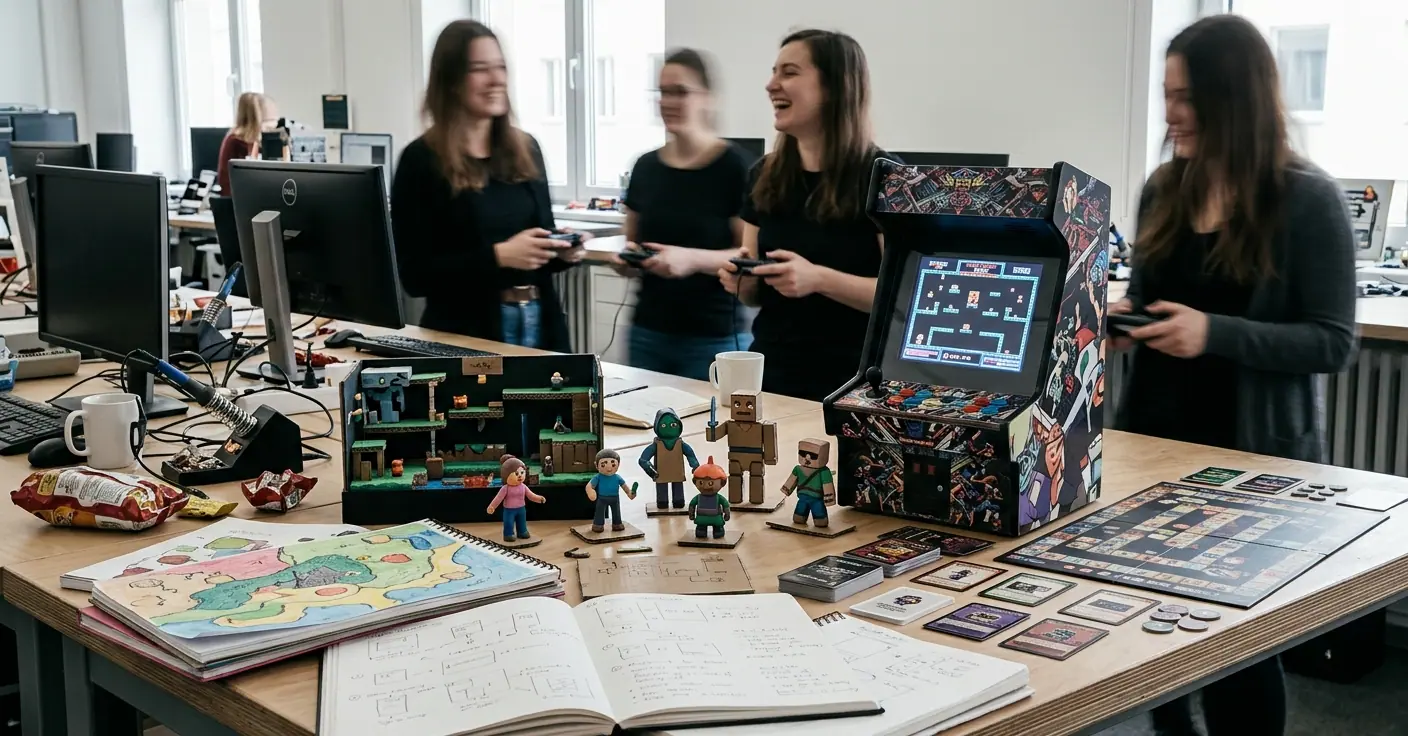
A hand-drawn logic map and a compiled game prototype look like different kinds of evidence. In this methodology, they occupy the same developmental record.
Researchers established a multi-modal coding scheme that weighted early conceptual work alongside final compiled code. Hand-drawn logic maps were digitized, while weekly game prototypes were archived in a central qualitative database for thematic analysis. That structure made it possible to follow the hand-drawn logic map to compiled prototype artifact progression without treating the sketch as disposable preparation.
Building the Artifact Record
The process can be read as a practical sequence:
- Capture the concept. Preserve logic maps and other early representations before implementation changes them.
- Archive each playable state. Retain weekly compiled prototypes rather than replacing one build with the next.
- Connect versions. Place conceptual artifacts, iteration records, and compiled outputs on a shared timeline.
- Code recurring decisions. Examine how ideas, mechanics, and programming structures develop across the record.
The intended observation window spans 24 to 36 months. That duration changes the unit of analysis. Researchers can study a trajectory of computational development instead of reading one polished game as a complete account of the learner’s capability.
The Resource Cost of Close Observation
This method requires substantial labor. Digitization, prototype archiving, screen-record review, qualitative coding, and cross-artifact analysis all demand sustained attention. The protocol also depends on a low student-to-researcher ratio, which currently restricts its practical use mainly to well-funded pilot programs rather than under-resourced public school classrooms.
That constraint belongs inside the methodology because it defines where the evidence can responsibly travel. A 24- to 36-month artifact record can illuminate development within the observed setting; it cannot automatically represent students whose learning environments were never captured with comparable depth.

The resource burden still carries an important lesson for everyday assessment. Schools may be unable to reproduce the entire research protocol, yet they can stop discarding drafts, sketches, and intermediate builds. Those materials hold traces of systems thinking that a final score routinely erases.
Design Moves That Signal Computational Capability
Consider a participant who changes a game mechanic after noticing that players cannot interpret an interaction as intended. The alteration is more than an aesthetic preference. She has identified a system-level problem, formed a hypothesis about its cause, modified the operative rule, and created a new state to test.
That sequence is a design move: a specific alteration that makes applied algorithmic thinking observable.
Connecting Changes to Explanations
The evaluation framework timestamped game-mechanic alterations in the development environment and cross-referenced them with audio transcripts from weekly participant interviews. Researchers focused on iteration logs generated during the middle portion of the curriculum.
The pairing matters. A code change records what happened, while the interview can clarify why the participant made it. Read together, they help distinguish an accidental edit from a deliberate attempt to test a computational idea. They also show how students name concepts in their own language before adopting formal terminology.
Follow the Decision
When evaluating a game revision, trace the issue the student noticed, the rule she changed, the outcome she expected, and the evidence she used to judge the result.
From Exploration to Structured Decisions
Early iteration may involve rapid trial and error. Later logs can reveal more deliberate choices: isolating one mechanic, predicting its effect, testing it, and retaining or revising the result. The developmental marker lies in how the decision process becomes structured over time.
I would therefore code the reasoning chain before assigning value to the polish of the prototype. A visually incomplete game can contain sophisticated conditional logic, careful user modeling, and a clear testing strategy. A smooth-looking build may offer far less evidence about who made the underlying computational decisions.
Interview excerpts provide essential context without becoming substitutes for the artifacts. The strongest interpretation emerges when the participant’s explanation, timestamped alteration, and subsequent prototype state align. Together, those materials locate theorizing inside the act of design and move the intersectional computational talent measurement boundary beyond syntax recall.
Making Portfolio Assessment the Institutional Standard
Changing the instrument changes what an institution can recognize. When educational systems privilege standardized testing, they reward performance in constrained settings and overlook the iterative design practices through which computational capability often becomes visible.
Advocacy around this research has therefore focused on a multi-phase transition from deficit-based testing toward portfolio-based computational assessment. Longitudinal tracking frameworks and artifact portfolios have been presented to district curriculum committees to demonstrate how asset-based evaluation can operate across time.
A District-Level Transition
The proposed implementation roadmap spans three to five years. That timeline gives districts room to sequence the work rather than treating portfolio assessment as a quick change to grading forms.
- Define which artifacts will be preserved, including conceptual maps, iteration logs, prototypes, and student explanations.
- Establish a consistent process for connecting artifacts across a learner’s design timeline.
- Prepare reviewers to identify design moves and interpret evidence across multiple formats.
- Present portfolios alongside existing measures while institutional expectations shift.
- Replace deficit-framed assessments with portfolio-based computational evaluation as the standard practice.
This transition affects more than measurement. It influences which learners receive recognition, whose ideas are treated as technically serious, and what forms of knowledge enter research & publications, initiatives & advocacy, speaking & engagements, and broader insights & perspectives about computing education.
Equity Requires the Whole Design Trail
Black girls’ computational talent cannot be amplified by systems that routinely delete the evidence of how they think. Sketches, interview reflections, code revisions, and playable builds collectively document intellectual work that syntax-first assessments leave outside the frame.
Districts should adopt portfolio-based longitudinal assessment as their primary measure of computational growth and begin the three- to five-year transition now. Preserve the design trail, evaluate the decisions within it, and make that evidence count.