Culturally responsive game design begins beneath the artwork. Character appearance matters, yet the deeper educational choices sit inside the rules: who controls resources, which movements carry risk, what counts as progress, and whose knowledge shapes the digital world.
A multi-year curriculum for African American middle school students examined this premise by connecting computational thinking to neighborhood narratives. Students gain meaningful authority when they can encode lived experience into the mechanics of a game, rather than decorate a structure someone else has already defined.
Rebuilding Game Mechanics From Lived Experience
On the order of thirty-six months of curriculum development, spanning 2019 through 2022, centered one foundational decision: reject the familiar practice of placing diverse avatars inside existing game templates. The research team built the mechanical framework from the ground up and asked students to define the physics and logic of their digital worlds through daily experience.
This choice changes the intellectual task. A prebuilt template asks students to learn its assumptions and work within them. A lived-experience framework asks students to identify assumptions, debate them, and then express them as computational rules.
Oral History Becomes Executable Logic
Neighborhood oral histories became source material for collision detection algorithms and resource management mechanics. That translation is more consequential than adding culturally familiar scenery. A story about where people gather, which routes feel accessible, or how resources move through a community can affect boundaries, object behavior, and player choices.
Collision detection offers a sharp example. In code, a collision determines what happens when entities meet: movement stops, an event begins, an object changes state, or access opens. When students map oral histories to those rules, they must decide what an encounter means within the community narrative. The algorithm becomes an argument about relationships and space.
Resource management prompts another set of questions. Which resources remain scarce? Who can obtain them? What actions replenish them? The answers become variables and conditions, so cultural interpretation enters the game at the systems level.
Mechanics Carry Values
Every game mechanic privileges certain actions. A scoring system might reward accumulation, cooperation, speed, care, or survival. Movement rules can make a place welcoming or difficult to enter. A timer can create urgency, while a resource constraint can force trade-offs.
I read this curriculum sequence as a direct challenge to a common assumption in computing education: technical rigor does not require cultural distance. Here, rigor emerges through the difficult work of converting a nuanced human account into precise, testable logic.
Why Diverse Avatars Leave the System Untouched
Two games can feature the same representative cast and offer entirely different cultural experiences. The difference sits in what players are allowed to do, which choices the game rewards, and how its systems interpret community life.
Traditional STEM outreach often concentrates representation in the visual layer. Students may see characters who resemble them while still inheriting mechanics, goals, and definitions of success created elsewhere. This curriculum moved representation into the architecture by making students responsible for the rules themselves.
Cognitive Tension as a Design Tool
The instructional modules deliberately created tension between flexible community narratives and rigid computational requirements. Stories can hold ambiguity, conflicting memories, and changing relationships. Code requires declared states, specified conditions, and predictable responses.
Students had to negotiate that gap. One concrete task involved programming custom variable states that reflected local community resource scarcity. To build those variables, students needed to determine what scarcity meant inside the narrative, how it could change, and what consequences followed each state.
That exercise turns cultural interpretation into a computational design problem. It also makes simplification visible. If a variable reduces a complex community issue too aggressively, students can inspect the rule, question the model, and revise the code.
From Interface Users to System Architects
Across a 14- to 16-week instructional block, students moved from block-based visual coding into text-based scripting environments. The progression preserved an accessible entry point while increasing the precision required to build custom systems.
The important transition involved more than syntax. Students shifted from selecting available actions to authoring possible actions. They determined how variables behaved, how events interacted, and how the digital environment responded to player decisions.
That is the point at which participation becomes architectural. Students no longer encounter technology solely as consumers navigating options. They define the options, establish the constraints, and make their cultural reasoning executable.
Sequencing Story, Logic, and Code
The framework followed a deliberate order. Cultural storytelling came first, computational abstraction followed, and implementation arrived only after students had established what their games needed to express.
A 90-minute weekly instructional block ran across a 24-week academic calendar. Within that structure, the teaching sequence paired milestones in narrative development with computational thinking concepts.
A Classroom Sequence That Protects the Story
- Develop the intersectional narrative. Students identify experiences, relationships, community conditions, and points of view that will shape the game world.
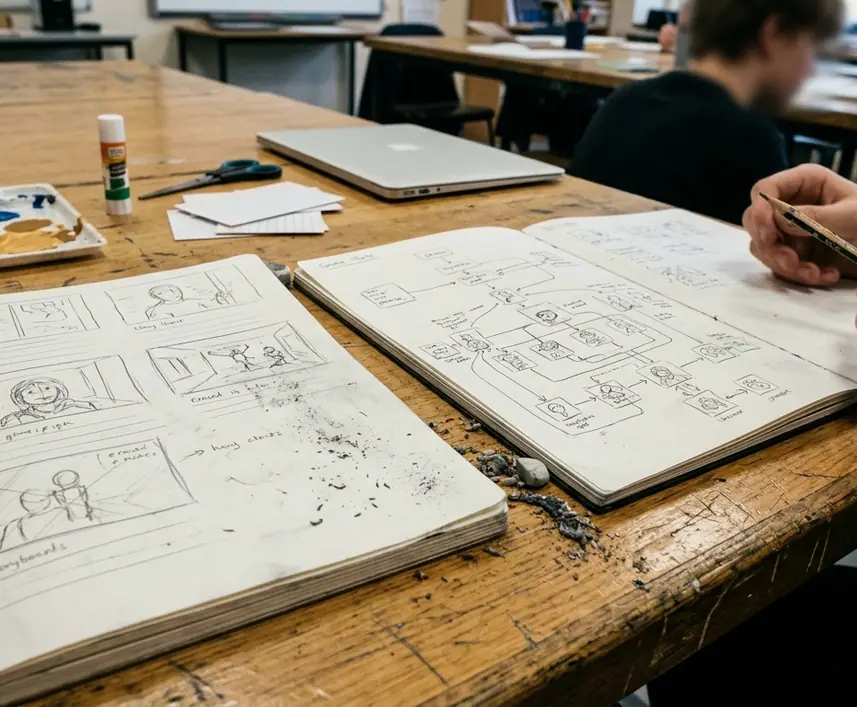
- Storyboard consequential moments. They mark where a player encounters a boundary, gains access, loses a resource, makes a choice, or changes the state of the environment.
- Extract computational elements. Story events become candidate variables, conditions, arrays, loops, and interactions.
- Define rules before writing full systems. Students specify what should happen, when it should happen, and which narrative meaning the rule carries.
- Implement and inspect the code. Testing examines both technical function and cultural accuracy.
Core logic loops entered the curriculum only after students had fully storyboarded their intersectional narratives. That sequencing matters. It keeps the programming language in service of the story and gives students a reason for each technical construct they encounter.
Intersectionality Inside Data Structures
Intersectional computing principles were integrated into conditional statements and array structures. A conditional can model how an outcome changes under a particular combination of circumstances. An array can organize related resources, locations, identities, or events without treating them as interchangeable.

The design decision lies in how those structures are framed. Instead of presenting a conditional as an isolated syntax exercise, the curriculum connects it to a narrative question: under which conditions does this character gain access, face a constraint, or influence the environment? Arrays likewise become a way to examine relationships among elements within the game world.
The current evidence should be applied at the scale in which the framework was designed. Its scope aligns specifically with middle school cognitive development. High school and collegiate cohorts would require deliberate pedagogical translation to account for more advanced abstract reasoning; simply extending the same pacing would overlook the developmental logic of the original sequence.
Turning Firewalls and School Rules Into Debugging Work
The collaborative coding repositories were ready. Restrictive district firewalls blocked access.
That obstacle surfaced during an initial four- to six-week pilot phase, alongside the broader institutional rigidity that often shapes classroom technology use. The facilitation team responded by bringing the constraint into the learning process instead of hiding it from students.
Administrative Constraints Become System Constraints
Local network access protocols were modified so the collaborative repositories could function around the restrictive firewall settings. The technical adjustment solved an immediate access problem, but the pedagogical response carried the larger lesson.
Students could see that digital environments operate within institutional systems. Platforms depend on permissions. Networks enforce rules. A technically sound project can still fail to run when its surrounding infrastructure blocks a required connection.
Framing these moments as live debugging exercises gave the class a method for examining friction:
- Identify the layer where access stops.
- Separate a code defect from a network or policy constraint.
- Determine which parts of the design remain under student control.
- Revise the implementation or delivery path without abandoning the cultural purpose of the project.
This approach also made institutional power legible. A firewall appears technical, yet its configuration determines which forms of collaboration a classroom can use. Culturally responsive computing has to account for that surrounding infrastructure because student agency cannot operate through inaccessible tools.
Iteration Follows the Classroom
The pilot phase gave the facilitation team a bounded period for adjusting curriculum delivery in response to actual access conditions, student feedback, and engagement levels. The framework therefore developed through use rather than remaining fixed at the planning stage.
Real-time feedback can expose several kinds of mismatch. A coding concept may arrive before the narrative is settled. A tool may introduce more operational friction than intellectual value. A project parameter may prevent students from representing an experience with the precision they want.
The useful response is targeted revision. Change the sequence, access path, or project structure while preserving the central commitment: students should retain authority over the cultural logic of the game.
Give Students the Final Architectural Decisions
Educators should design the conditions for rigorous computing work, then hand meaningful design authority to students.
In this curriculum, the final eight to ten weeks of the academic year were allocated entirely to student-led project architecture. That span gave students room to determine final project parameters rather than merely completing an educator-authored specification.
Co-Design Requires Concrete Authority
Student voice becomes consequential when it changes the syllabus, mechanics, or evaluation process. Asking for preferences while preserving every predetermined outcome offers limited power. A co-design phase creates a defined point at which students can set the scope of the final environment and decide which community narratives the code must carry.
Educators adapting this model can protect its core through several decisions:
- Reserve substantial project time for student-led architecture.
- Let students define final parameters that affect rules, resources, movement, and outcomes.
- Connect each computational structure to a narrative purpose.
- Assess whether the code behaves correctly and whether its behavior reflects the intended cultural account.
- Treat revisions to the curriculum as part of implementation, especially when student feedback identifies a structural mismatch.
Peers Debug Cultural Accuracy
Peer-review debugging sessions extended assessment beyond code execution. Students evaluated the cultural accuracy of one another’s systems, creating a review process in which a functioning mechanic could still be questioned.
Does the resource rule flatten the community narrative? Does a conditional make access seem automatic when the story describes a more complicated relationship? Does the game reward behavior that conflicts with its stated values? These questions join technical debugging with interpretation and accountability.
Educators can establish time, technical support, and demanding standards, while students supply the knowledge needed to define culturally grounded systems. Surrender absolute control of the final project architecture and make student co-design a required part of the computing curriculum.